Building Fear in Unreal Engine: Lighting, Sound Design, and Atmosphere
A deep dive into how we're creating tension and atmosphere in our Unreal Engine horror game through lighting, environmental storytelling, audio design, and gameplay systems.
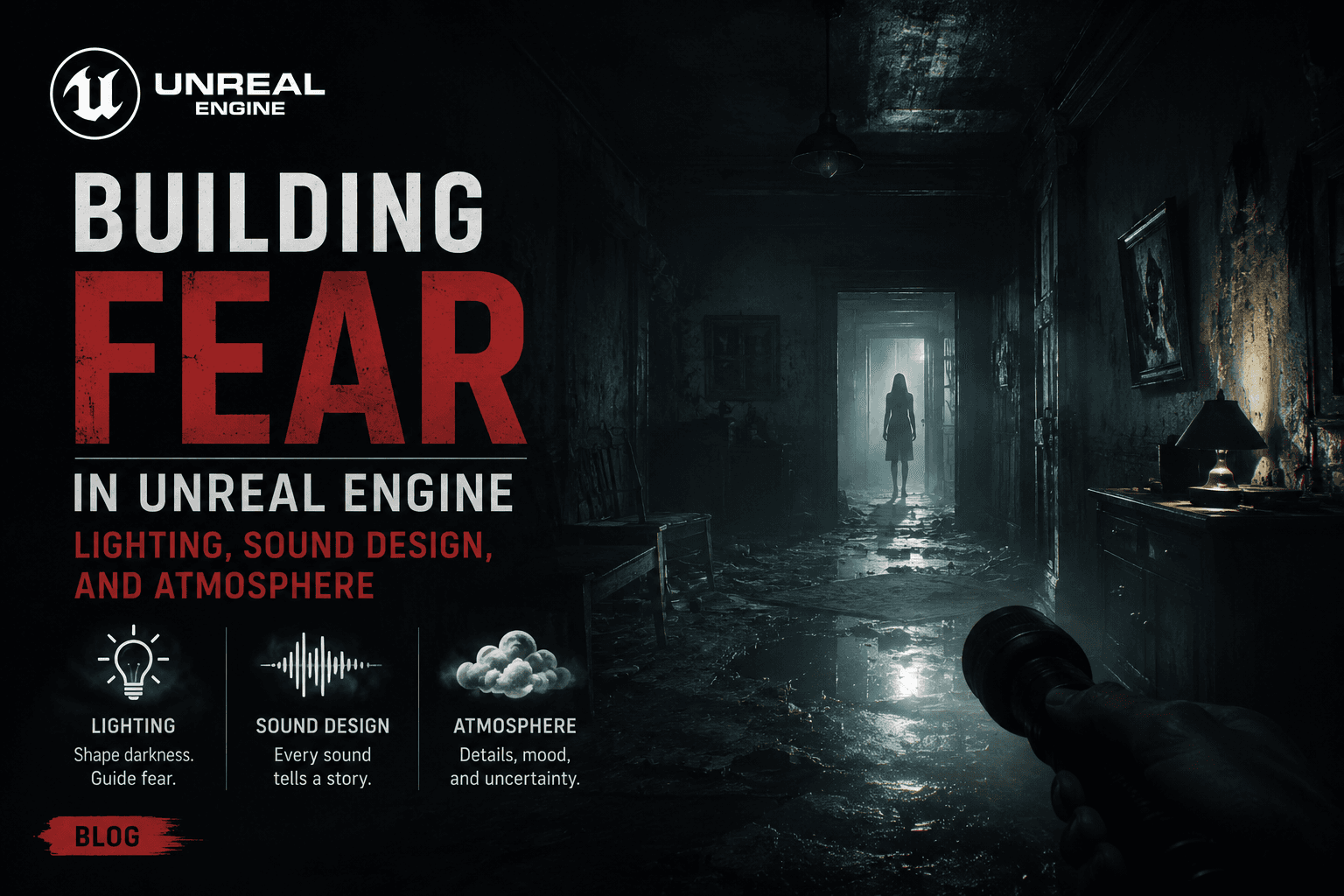
Horror is rarely about what the player sees. More often, it's about what they think might be waiting around the next corner.
Introduction
Over the past few weeks, we've been focused on one of the most important aspects of horror game development: atmosphere.
While enemy AI and gameplay systems are important, players often remember the tension they felt while exploring an abandoned hallway, hearing distant footsteps, or staring into a dark room where nothing seemed to happen.
In this devlog, I'll share some of the techniques and design decisions we've been using to build a stronger horror experience in Unreal Engine.
Creating Tension Through Lighting
Lighting is one of the most powerful tools available to horror developers.
Early versions of our levels were technically correct, but they felt safe. Players could clearly see their surroundings, which removed much of the uncertainty that makes horror effective.
To address this, we focused on:
- Increasing shadow contrast
- Limiting visibility in key areas
- Using volumetric fog to obscure distant spaces
- Creating visual focal points with selective lighting
- Guiding players through subtle environmental cues
Darkness vs Visibility
One common mistake in horror games is making everything too dark.
Complete darkness often creates frustration instead of fear. Players need just enough information to imagine what might be hidden in the shadows.
Our goal is to maintain a balance between:
- Visibility
- Uncertainty
- Player comfort
- Psychological tension
Environmental Storytelling
Rather than relying solely on dialogue or cutscenes, we're using the environment itself to tell stories.
Players can discover clues through:
- Abandoned furniture
- Personal belongings
- Written notes
- Damaged architecture
- Signs of previous events
Each room should communicate something about what happened there before the player arrived.
Building Questions Instead of Giving Answers
A useful rule we've been following:
Answering every question removes mystery.
Instead of explaining everything directly, we prefer to give players fragments of information that encourage them to form their own theories.
This approach tends to create stronger emotional engagement and longer-lasting tension.
Sound Design and Psychological Horror
Audio plays a huge role in horror experiences.
In many situations, players hear danger long before they see it.
Recent improvements include:
- Layered ambient soundscapes
- Dynamic audio zones
- Randomized environmental sounds
- Directional audio cues
- Reactive music systems
Dynamic Audio Zones
Different areas of the map now have unique sound profiles.
| Area | Audio Design |
|---|---|
| Hallways | Wind, distant creaks |
| Basement | Low-frequency drones |
| Attic | Occasional impacts and scratching |
| Threat Zones | Increased tension layers |
These subtle transitions help players feel when something is changing, even if they don't consciously notice it.
Unreal Engine Workflow
Most gameplay features begin as rapid prototypes.
We typically start with Blueprints before deciding whether a system needs a C++ implementation.
Benefits of this workflow include:
- Faster iteration
- Easier testing
- Better collaboration between disciplines
- Reduced development overhead during experimentation
Example logic:
if (DistanceToPlayer <= DetectionRange)
{
    CurrentState = EEnemyState::Alert;
}
Once a feature proves valuable, we optimize and refactor where necessary.
Performance Considerations
Atmospheric horror environments can become expensive quickly.
Features such as:
- Lumen
- Nanite
- Volumetric Fog
- Dynamic Shadows
- High-resolution textures
all contribute to visual quality, but they also impact performance.
Recent optimization work included:
- Reducing unnecessary shadow-casting lights
- Improving texture streaming behavior
- Optimizing mesh complexity
- Reviewing GPU-heavy post-processing effects
- Adjusting fog settings per level section
Profiling First, Optimizing Second
One lesson we continue to reinforce:
Never optimize blindly.
Before making changes, we always profile the game using Unreal Insights and GPU Visualizer to identify actual bottlenecks.
Enemy Encounters
Our design philosophy for enemy encounters is simple:
The player should fear the possibility of seeing an enemy more than the enemy itself.
To support this idea:
- Encounters are relatively rare
- Audio cues often precede appearances
- Enemy behavior is intentionally unpredictable
- Safe zones are limited
This creates anticipation, which is often more effective than constant action.
Challenges We're Facing
Current development challenges include:
- Balancing atmosphere and performance
- Preventing repetitive scare patterns
- Improving AI navigation in complex environments
- Maintaining visual consistency across levels
- Expanding environmental storytelling opportunities
Development Checklist
- Initial atmosphere pass completed
- Dynamic audio system implemented
- Environmental storytelling iteration
- Advanced enemy behaviors
- Save system improvements
- Additional optimization pass
- New playable area
Looking Ahead
Our next milestone focuses on expanding exploration and strengthening the psychological horror elements of the experience.
Upcoming goals include:
- New environmental storytelling sequences
- Additional enemy behavior variations
- Enhanced audio reactivity
- Further performance optimization
- Playtesting and balancing
As always, every iteration teaches us something new about what makes players feel genuinely uncomfortable—and that's exactly where the most interesting horror design begins.